On this page
Quick answer
A Florida criminal case generally moves through arrest, first appearance, a charging decision by the State Attorney, arraignment, discovery, pretrial hearings, and then a resolution by plea, trial, dismissal, or diversion. If there is a conviction, sentencing follows, and an appeal may be filed within 30 days. Not every case includes every stage, and timing varies widely.
Key takeaways
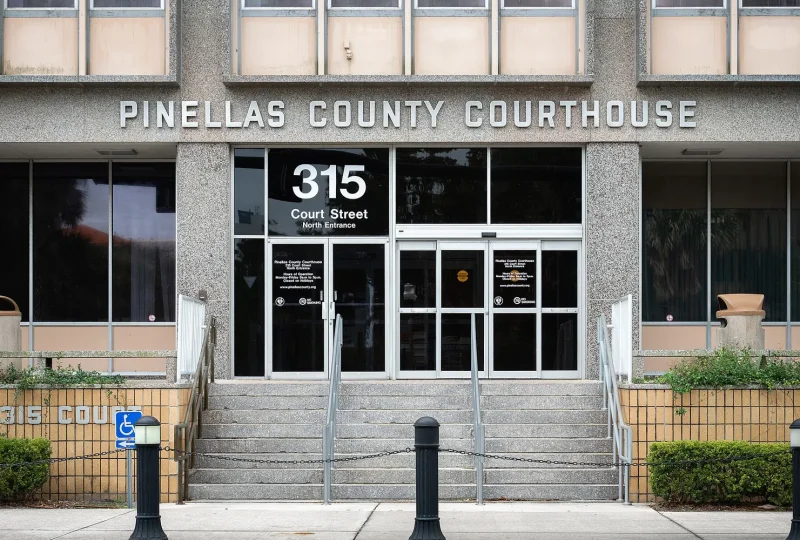
- Misdemeanors are handled in county court and felonies in circuit court. In Pinellas County both sit at the Pinellas County Justice Center.
- The prosecutor, not the arresting officer, decides what formal charge to file.
- Florida’s speedy trial rule sets default periods of 90 days for a misdemeanor and 175 days for a felony, counted from the formal charge. They are often waived.
- The State has the burden of proving every element of the charge beyond a reasonable doubt.
- Most cases end without a trial, through a plea, a dismissal, or a diversion program.
The stages at a glance
| Stage | What it is for | Governing rule or law |
|---|---|---|
| First appearance | Probable cause, counsel, and conditions of release | Rule 3.130 |
| Charging decision | The State Attorney files an information, or declines to | Rules 3.134 and 3.140 |
| Arraignment | The charge is read and a plea is entered | Rule 3.160 |
| Discovery | Each side discloses evidence and witnesses | Rule 3.220 |
| Pretrial | Motions, hearings, and plea discussions | Rules 3.170 to 3.190 |
| Trial | A jury or judge decides guilt | Rules 3.250 to 3.440 |
| Sentencing | The judge imposes sentence after a plea or guilty verdict | Chapters 775, 921, and 948 |
| Appeal | A higher court reviews claimed legal errors | Appellate Rule 9.140 |
Rule numbers refer to the Florida Rules of Criminal Procedure unless noted. You can also step through these stages in the court process guide.
Arrest and first appearance
A person who is arrested and not released is brought before a judge within 24 hours. The judge reviews probable cause, addresses legal representation, and sets conditions of release. See what happens after an arrest in Florida and bail, bond, and release in Pinellas County.
The charging decision
After reviewing the police reports and any other evidence, an assistant state attorney decides whether to file formal charges. In Florida most charges are filed in a document called an information. Capital crimes require a grand jury indictment. The prosecutor may file a different charge from the one listed at arrest, or may decline to file any charge.
Arraignment
At arraignment the court tells the defendant what the formal charge is, and the defendant enters a plea of not guilty, guilty, or, with the court’s consent, no contest. A defendant who has a lawyer may be able to enter a written plea of not guilty without attending.
Discovery
Florida has broad criminal discovery under Rule 3.220. When the defense elects to participate, the State must disclose, among other things, the names of witnesses, statements, police reports, and physical and scientific evidence, and the defense takes on disclosure duties of its own. In many cases the defense may take depositions of witnesses. Separately, the prosecution has a constitutional duty to disclose evidence favorable to the defense, often called Brady material.
Pretrial motions and hearings
Before trial, either side can ask the court to rule on legal issues. Common examples are a motion to suppress evidence said to have been obtained unlawfully and a motion to dismiss. The court also holds pretrial conferences to check whether the case is ready for trial. A hearing can be rescheduled by a continuance.
Resolution without a trial
Most criminal cases are resolved before trial. The main routes are:
- Dismissal. The prosecutor can drop a charge by filing a nolle prosequi, or the court can dismiss it.
- Diversion. Programs such as pretrial intervention under section 948.08, Florida Statutes allow eligible defendants to complete conditions in exchange for dismissal. Eligibility is limited, and for pretrial intervention the prosecutor must consent.
- A plea. A defendant may plead guilty or no contest, sometimes under an agreement with the State about the charge or the sentence. Before accepting a plea, the judge must confirm that it is voluntary and that the defendant understands the rights being given up (Rule 3.172).
Trial
A defendant who pleads not guilty has the right to a trial. Key features under Florida law:
- Juries have six members, except in capital cases, which have twelve (section 913.10, Florida Statutes).
- Jury selection is called voir dire.
- The State must prove each element of the offense beyond a reasonable doubt.
- The defendant cannot be required to testify.
- A verdict of guilty or not guilty must be unanimous.
Speedy trial
Rule 3.191 gives a defendant the right to be brought to trial within 90 days if the charge is a misdemeanor and within 175 days if it is a felony. Under the rule as currently published, these periods begin when the person is formally charged, not on the date of arrest. A person is formally charged by an information or an indictment or, for a misdemeanor, by whatever document serves as the formal charge. The periods are frequently waived or extended, often at the request of the defense, to allow more time to prepare. Waiving speedy trial has consequences, so it is a decision usually made with a lawyer.
Sentencing
After a guilty or no-contest plea or a guilty verdict, the judge imposes sentence. Depending on the offense, the options can include jail or prison, probation, fines, restitution, community service, and treatment programs. In some cases the judge may withhold adjudication of guilt. Felony sentencing uses the Criminal Punishment Code scoresheet, described in our guide to felony charges in Florida. The maximum for each offense level is listed in the offense level reference.
Appeal and what comes after
A defendant who wants to appeal generally must file a notice of appeal within 30 days after the written sentence is rendered (Florida Rule of Appellate Procedure 9.140). After a case ends, other questions can arise, including violations of probation under section 948.06, Florida Statutes and whether the record can be sealed or expunged.
Common questions
How long does a criminal case take in Florida?
It varies with the charge, the court’s calendar, and how much investigation is needed. Some misdemeanors end in weeks. Felony cases often take many months and can take more than a year.
Does the defendant have to attend every hearing?
Not always. A lawyer can sometimes appear on a defendant’s behalf, particularly in misdemeanor cases, but a defendant must attend any hearing the court requires. Missing a required hearing can lead to a warrant.
Can criminal charges be dropped?
Yes, but the decision belongs to the prosecutor, not to the person who made the complaint. A prosecutor can continue a case even when the alleged victim asks for it to end.
What is the difference between county court and circuit court?
County court handles misdemeanors. Circuit court handles felonies.
When to speak with an attorney
Each stage involves deadlines and decisions that are hard to undo, such as what plea to enter and whether to waive speedy trial. A licensed Florida attorney can explain how the rules apply to a specific case. A person who cannot afford a lawyer can ask the court to appoint the public defender. To prepare, see how to prepare for an attorney consultation.
Official resources and sources
- Florida Rules of Criminal Procedure — published by The Florida Bar
- Section 948.08, Florida Statutes — pretrial intervention program
- Section 913.10, Florida Statutes — number of jurors
- Section 948.06, Florida Statutes — violation of probation or community control
- Florida Courts — the state courts system
- Sixth Judicial Circuit of Florida — courts for Pinellas and Pasco counties