On this page
Quick answer
After an arrest in Florida, a person is booked into the county jail and, unless released first, is brought before a judge for a first appearance within 24 hours. At that hearing the judge reviews whether there was probable cause for the arrest, addresses whether the person has a lawyer, and decides the conditions of release. The State Attorney then decides whether to file formal charges, and an arraignment follows.
Key takeaways
- An arrest is not a conviction. It begins a process in which the State must prove the charge.
- First appearance is required within 24 hours of arrest under Florida Rule of Criminal Procedure 3.130. No plea is entered at that hearing.
- Some people can post a bond from the bond schedule before first appearance; others are required by statute to see a judge first.
- A person who cannot afford a lawyer can ask for the public defender at first appearance.
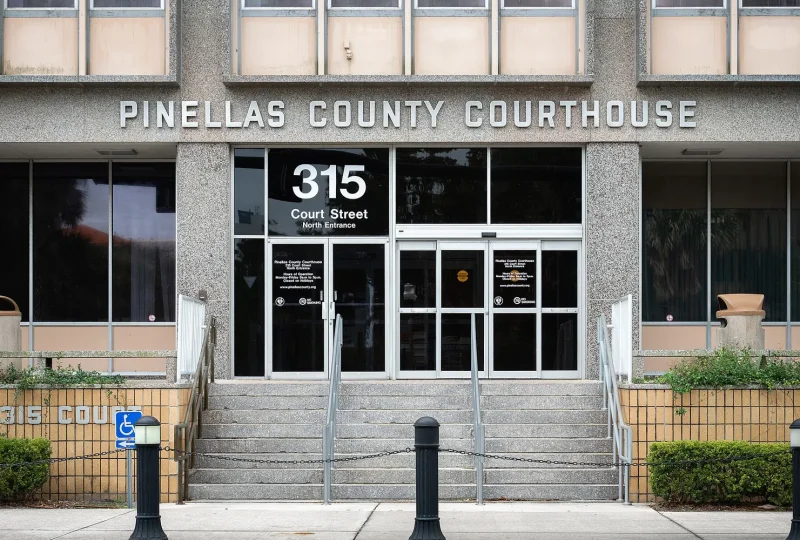
- In Pinellas County, criminal cases are heard at the Pinellas County Justice Center in Clearwater.
Step 1: The arrest
An officer may arrest a person with a warrant, or without one when the officer has probable cause to believe the person committed a crime. After the arrest the person is searched and taken to jail.
A person who is arrested has the right to remain silent and the right to a lawyer. Miranda warnings are required before custodial questioning, not at the moment of every arrest. Florida law does not allow a person to use force to resist an arrest, even one they believe is unlawful (section 776.051, Florida Statutes). The place to challenge an arrest is in court. Our guide to your rights in Florida covers these protections in more detail.
Step 2: Booking
Booking is the jail’s intake process. Staff record identifying information and the charges, take fingerprints and a photograph, and inventory personal property. In Pinellas County this happens at the Pinellas County Jail in Clearwater, which is run by the Sheriff’s Office. Once booking is complete, custody information is generally available through the Sheriff’s Office.
Phone calls from jail are generally recorded, other than properly arranged calls with an attorney.
Step 3: Release before first appearance, if allowed
Florida uses a statewide uniform bond schedule, adopted by the Florida Supreme Court under section 903.011, Florida Statutes. For many lower-level charges, a person can post the scheduled bond and be released without waiting to see a judge.
The same statute lists people who may not be released before first appearance. The list includes a person arrested for a felony while already on pretrial release, probation, or community control; a person arrested for violating a protective injunction; and a person charged with certain serious offenses. Our guide to bail, bond, and release in Pinellas County explains the options.
Step 4: First appearance
If the person is still in custody, they must be brought before a judge within 24 hours of arrest. In Pinellas County these hearings, often called advisories, are held at the Pinellas County Justice Center, and the arrested person commonly appears by video from the jail. At a first appearance the judge:
- tells the person what they are charged with and advises them of their rights;
- decides whether there was probable cause for a warrantless arrest;
- asks whether the person has a lawyer and appoints the public defender if the person qualifies; and
- sets the conditions of pretrial release.
No plea is entered at first appearance, and the hearing is not a trial.
Asking for the public defender
A person who cannot afford a lawyer applies by completing a financial affidavit. Section 27.52, Florida Statutes, sets a $50 application fee, which can be assessed later if it is not paid at the time.
Step 5: Release and its conditions
Release always comes with conditions. Under section 903.047, Florida Statutes every person on pretrial release must refrain from criminal activity and, if the court orders it, from contact with the alleged victim. A judge can add others, such as travel limits or electronic monitoring.
Violating a condition can lead to arrest and to release being revoked. Since October 1, 2026, a law passed that year also makes it a separate crime to willfully violate a no-contact order while on pretrial release for certain violent offenses.
Step 6: The charging decision
An arrest report is not the formal charge. A prosecutor in the State Attorney’s Office reviews the case and decides whether to file charges and which ones. In Florida the charging document is usually called an information. Capital crimes are charged by a grand jury indictment. The prosecutor can file the charge the officer listed, a different charge, or no charge at all.
When a person is still in jail, Florida Rule of Criminal Procedure 3.134 requires the State to file formal charges within 30 days of the arrest, with limited extensions, or the person must be released on their own recognizance.
Step 7: Arraignment
At arraignment the charge is read and the person enters a plea. This is usually the first hearing after formal charges are filed. From here the case moves into discovery and pretrial hearings, which our guide to the Florida criminal court process explains stage by stage.
For family and friends
- Custody status and charges can be checked through the Pinellas County Sheriff’s Office.
- Court dates and case records are available from the Pinellas County Clerk of the Circuit Court.
- Do not discuss the facts of the case on a jail phone line.
- Keep every document: the arrest paperwork, bond paperwork, and any notice of a court date.
Common questions
Can a person be arrested and never charged?
Yes. The State Attorney may decline to file charges, sometimes called a “no information.” The arrest still appears in the person’s criminal history unless the record is later sealed or expunged.
How long can someone be held before seeing a judge?
The rule requires a first appearance within 24 hours of arrest.
What is the difference between being charged and being convicted?
A charge is an accusation filed by the prosecutor. A conviction happens only after a guilty or no-contest plea or a guilty verdict at trial.
What happens if someone misses a court date?
The court can issue a warrant and order the bond forfeited, and failing to appear is a separate offense under section 843.15, Florida Statutes.
When to speak with an attorney
Decisions made in the first days, including what to say and to whom, can affect the rest of the case, which is why many people speak with a licensed Florida attorney as early as possible. If you are preparing for that conversation, the attorney consultation checklist and our guide on how to prepare for an attorney consultation may help.
Official resources and sources
- Florida Rules of Criminal Procedure — Rule 3.130 (first appearance), Rule 3.134 (time for filing formal charges), Rule 3.160 (arraignment)
- Section 903.011, Florida Statutes — pretrial release and the uniform bond schedule
- Section 903.047, Florida Statutes — conditions of pretrial release
- Section 27.52, Florida Statutes — determination of indigent status
- Pinellas County Justice Center — Sixth Judicial Circuit
- Pinellas County Sheriff’s Office — jail and custody information
- Pinellas County Clerk of the Circuit Court — court records
- Office of the Public Defender, Sixth Judicial Circuit