On this page
Quick answer
Before meeting a criminal defense attorney, gather every document you received, write down your court dates and any deadlines, and prepare a short list of questions about the charge, the process, fees, and communication. What you tell a lawyer you are consulting is confidential even if you do not hire them. If you cannot afford a lawyer, you can ask the court to appoint the public defender.
Key takeaways
- Bring the paperwork: it tells a lawyer the exact charge, the court, and the dates.
- Check that the lawyer is licensed and in good standing using The Florida Bar’s public member search.
- Ask how the fee works and get the agreement in writing. Contingency fees are not allowed in criminal defense.
- No ethical lawyer can promise a result.
- The public defender is available to people who cannot afford a lawyer and face possible jail or prison.
Documents to gather
- Government-issued photo identification.
- The arrest report, citation, or notice to appear.
- Bond paperwork and any written conditions of release.
- Every notice from the court or the clerk, especially anything showing a hearing date.
- For a DUI arrest: the notice of license suspension, which starts the 10-day period described in DUI in Florida.
- Any letters from the State Attorney’s Office.
- Names and contact details of possible witnesses.
- Photographs, messages, receipts, or other records that relate to what happened.
Do not alter or delete anything, including messages and social media posts.
Write down the dates
List the date of the arrest, every court date you have been given, and any deadline printed on your paperwork. Some deadlines are short, and a lawyer will ask about them first. The court date planner can keep these in one place.
Questions about the case
- What exactly am I charged with, and what would the State have to prove?
- What is the maximum penalty, and are there any mandatory minimums?
- What are the next steps and deadlines?
- What are the possible ways this type of case can be resolved?
- Could this affect my driver license, job, professional license, immigration status, or ability to seal the record?
- What should I avoid doing while the case is pending?
Questions about the lawyer
- How much of your practice is criminal defense, and do you regularly appear in this county’s courts?
- Will you handle my case personally, or will another lawyer in the office?
- How will we communicate, and how quickly do you usually respond?
- Are you board certified in criminal trial law by The Florida Bar?
You can confirm that a lawyer is licensed and see any public discipline history through The Florida Bar’s member search. Under the Bar’s rules, only board-certified lawyers may describe themselves as specialists or experts in a field.
Questions about fees
Criminal defense lawyers commonly charge a flat fee for a defined stage of the case, or an hourly rate against a deposit. Ask:
- Is the fee flat or hourly, and what does it cover?
- Is a trial included, or is that a separate fee?
- Are costs such as investigators, experts, and transcripts extra?
- Is any part of the fee nonrefundable?
The Rules Regulating The Florida Bar prohibit contingency fees in criminal defense, meaning a fee that depends on the outcome (Rule 4-1.5). A written fee agreement protects both sides.
What to expect from the meeting
- Confidentiality. A lawyer owes duties of confidentiality to a prospective client, even if no lawyer-client relationship follows (Rule 4-1.18 of the Rules Regulating The Florida Bar addresses prospective clients).
- Honest ranges, not promises. A lawyer can describe possible outcomes and how the process works. A lawyer cannot guarantee a result, and one who does should give you pause.
- Time to decide. You do not have to hire the first lawyer you meet.
If you cannot afford a lawyer
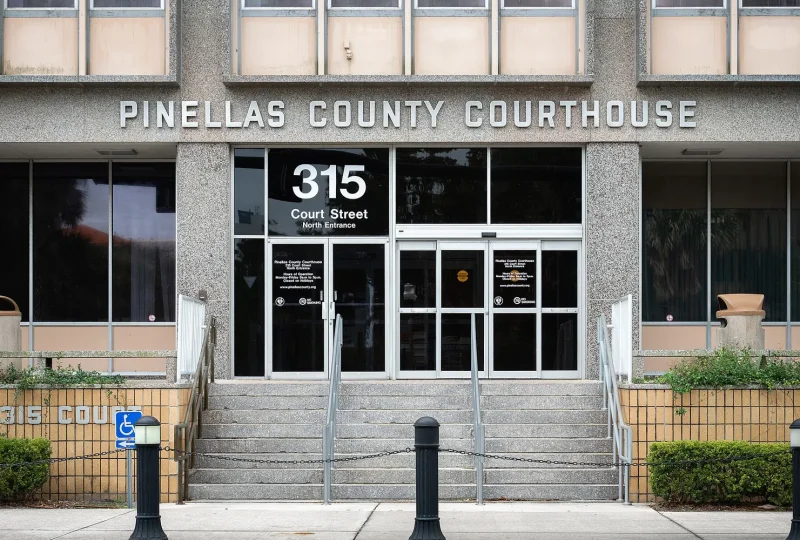
A person charged with an offense that carries possible jail or prison time, and who cannot afford a lawyer, can ask the court to appoint the public defender. The request is normally made at first appearance or arraignment and requires a financial affidavit. In Pinellas County this is the Office of the Public Defender for the Sixth Judicial Circuit.
The Florida Bar also operates a statewide Lawyer Referral Service for people looking for a private lawyer.
Common questions
Should I talk to more than one lawyer?
If time allows, many people do. Comparing how clearly each lawyer explains the process can be as useful as comparing fees.
Is what I say in a consultation confidential?
Yes, in general. Florida’s professional rules protect information a prospective client shares in good faith when seeking representation.
Can I speak to the police or the prosecutor before I have a lawyer?
You have the right to remain silent and the right to a lawyer, and you can say that you want to speak with a lawyer first. See your rights in Florida.
Build your own checklist
The attorney consultation checklist turns the points above into a printable list tailored to the type of charge and the stage of the case.
Official resources and sources
- Find a Lawyer — The Florida Bar: licence status and public discipline history
- Lawyer Referral Service — The Florida Bar
- Rules Regulating The Florida Bar — including Rule 4-1.5 (fees) and the rules on prospective clients
- Office of the Public Defender, Sixth Judicial Circuit — Pinellas and Pasco counties
- Section 27.52, Florida Statutes — determination of indigent status