On this page
Quick answer
A first appearance is the hearing that a person who has been arrested and is still in jail must have before a judge within 24 hours of the arrest. The judge explains the charge and the person’s rights, deals with whether the person has a lawyer, reviews probable cause for the arrest, and decides the conditions of release. It is not a trial, and the judge does not decide guilt. In Pinellas County these hearings are called advisories and are held at the Pinellas County Justice Center in Clearwater.
Key takeaways
- Florida Rule of Criminal Procedure 3.130 requires the hearing within 24 hours of arrest, unless the person has already been lawfully released.
- The judge must warn the person that they do not have to say anything and that anything they say can be used against them.
- A public defender attends, and a lawyer is appointed at the hearing for a person who qualifies and wants one.
- The judge is not bound by the bond schedule and can release a person without money, set a bond, or add conditions.
- Some people cannot post bond before the hearing, including anyone arrested for domestic violence.
What a first appearance is for
The first appearance is the first time a judge looks at the case. Florida Rule of Criminal Procedure 3.130 sets out what has to happen: the judge gives notice of the charge, addresses the right to a lawyer, reviews probable cause, and decides release. The rule does not provide for a plea, which is entered later at arraignment.
Who has a first appearance
Every arrested person who has not already been lawfully released must be taken before a judge within 24 hours. A person who posts the scheduled bond and leaves the jail first does not have one. Their paperwork, or a later notice from the clerk, gives the next court date.
Some people may not post bond before the hearing. Under section 903.011, Florida Statutes, they include a person who:
- was arrested for domestic violence, stalking, felony battery, robbery, or burglary;
- was arrested for a capital, life, first-degree, or second-degree felony, or for drug trafficking;
- was arrested for a felony while on pretrial release, probation, or community control;
- was arrested for violating a protective injunction; or
- was arrested three or more times in the previous six months.
The statute’s full list is longer.
Notice of the charge and of the person’s rights
The judge must immediately tell the person what they are charged with and give them a copy of the complaint. The judge must also advise that:
- the person is not required to say anything, and anything they say may be used against them;
- they have a right to a lawyer, and one will be appointed if they cannot afford one; and
- they have a right to communicate with a lawyer, family, or friends.
The right to a lawyer at the hearing
Rule 3.130 requires a prosecutor and a public defender to attend. If the judge finds that the person is entitled to a court-appointed lawyer and wants one, the judge must appoint one immediately, before anything else is decided. A person who has hired a lawyer, or wants to, must be given reasonable time to send for the lawyer. The right can be given up for this hearing only in a signed, written waiver, and the waiver does not carry over to later proceedings.
A request for the public defender is made on a financial application to the clerk. Section 27.52, Florida Statutes, sets a $50 application fee and says a person found indigent may not be refused a lawyer for failing to pay it.
The probable cause review
When a person is arrested without a warrant and stays in custody, Rule 3.133 requires a judge to decide within 48 hours of the arrest whether there was probable cause. The decision is made at first appearance if the proof is available, and it can rest on sworn documents such as the arrest affidavit. If the judge does not find probable cause, the person is released, but the rule says that does not prevent the State from prosecuting later.
The release decision
Rule 3.131 states a presumption in favor of release on nonmonetary conditions. The judge chooses the first option on this list that will reasonably protect the community and make sure the person returns to court, or a combination of them:
- release on the person’s own recognizance (ROR);
- an unsecured appearance bond;
- nonmonetary conditions, such as a curfew, travel limits, or regular reporting; or
- a bail bond or a cash deposit.
The judge considers the charge, the weight of the evidence, the person’s ties to the community, any record of convictions or missed court dates, and the danger a release would pose. The judge is not bound by the bond schedule and sets a separate amount for each charge. No contact with the alleged victim is a condition of release unless the court changes it.
A stricter rule applies to the “dangerous crimes” listed in section 907.041, Florida Statutes: if the judge finds probable cause for one, nonmonetary release may not be granted at first appearance. The State can also ask for pretrial detention, which is decided at a separate hearing. Our guide to bail, bond, and release in Pinellas County explains the types of bond.
First appearance in Pinellas County
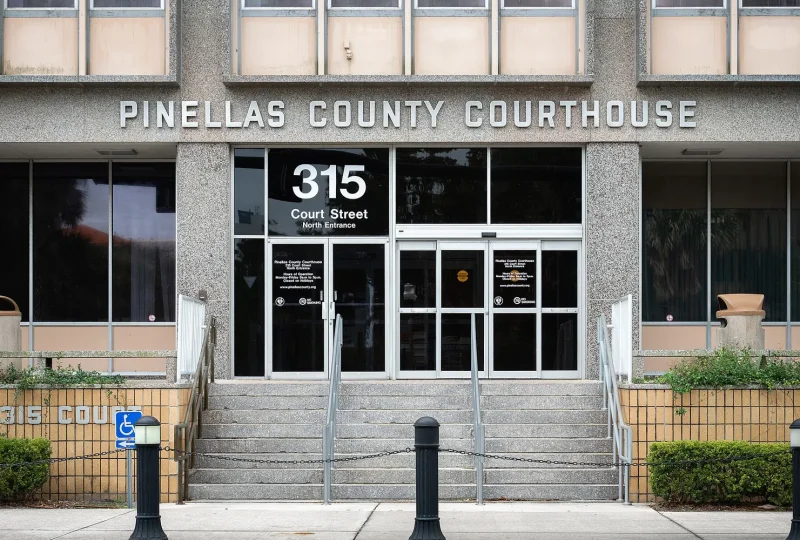
- Where. The Pinellas County Justice Center, 14250 49th Street North, Clearwater, FL 33762, which houses the circuit and county courts and the Clerk of Court. Parking is free, and all visitors pass through security screening.
- When. The 24-hour rule applies every day. The Sixth Judicial Circuit’s duty judge calendar lists an advisory judge on weekends and holidays from 8:30 a.m. to about noon. Confirm the current schedule with the court or the Clerk before travelling.
- How. Rule 3.130 allows the hearing to be held in person or by audio-video link, so a person in custody may appear on a screen from the jail.
- Who to contact. The Sheriff’s Office runs the jail and publishes custody information. The Clerk of the Circuit Court keeps the court file and hearing dates.
What happens next
- If the person is released, the conditions apply at once, and violating one can lead to arrest.
- If the person cannot post the bond, a motion can ask the court to reconsider the amount.
- If the person stays in jail, Rule 3.134 requires the State to file formal charges within 30 days of the arrest. Otherwise the court must order release on the person’s own recognizance on the 33rd day, or on the 40th day if the State shows good cause, unless charges are filed by then.
Our guides to what happens after an arrest in Florida and how the Florida criminal court process works cover the stages before and after this hearing. More guides are on the Arrest & Court Process and Pinellas County topic pages.
Common questions
Is a first appearance the same as an arraignment?
No. First appearance happens within 24 hours of arrest and deals with rights, a lawyer, probable cause, and release. Arraignment comes after the State Attorney files formal charges and is where a plea is entered.
Can the charge be dropped at first appearance?
The judge reviews probable cause and release. The decision whether to file, change, or drop a charge belongs to the State Attorney and is made separately.
Should a person explain what happened to the judge?
The judge is required to warn that anything said can be used against the person. The hearing is about release, not the facts of the charge. See your rights in Florida.
When to speak with an attorney
A lawyer can appear at first appearance, tell the judge about a person’s ties to the community, and ask for release conditions the person can meet. A person who cannot afford a lawyer can ask for the public defender at the hearing. If you are arranging a lawyer for someone else, the attorney consultation checklist lists what a lawyer will ask for.
Official resources and sources
- Florida Rules of Criminal Procedure — Rules 3.130, 3.131, 3.132, 3.133, and 3.134, as published October 1, 2026
- Section 903.011, Florida Statutes — who may not be released before first appearance
- Section 907.041, Florida Statutes — pretrial detention; dangerous crimes
- Section 27.52, Florida Statutes — determination of indigent status
- Pinellas County Justice Center — address, hours, parking, and security
- Sixth Judicial Circuit of Florida — court calendars, including the duty judge calendar
- Pinellas County Sheriff’s Office — jail and custody information
- Pinellas County Clerk of the Circuit Court — court records and hearing dates
- Office of the Public Defender, Sixth Judicial Circuit