On this page
Quick answer
In Florida, a misdemeanor is a crime punishable by up to one year in a county jail. There are two levels. A second-degree misdemeanor carries up to 60 days in jail and a fine of up to $500. A first-degree misdemeanor carries up to one year in jail and a fine of up to $1,000. Misdemeanors are handled in county court, and a conviction is a criminal record.
Key takeaways
- The degree sets the maximum sentence, not the expected one.
- A person who cannot afford a lawyer is entitled to an appointed one whenever jail is a possible outcome.
- The speedy trial period for a misdemeanor is 90 days from the date of the formal charge.
- Some misdemeanors, including battery and petit theft, become felonies when the person has prior convictions.
- An adjudication of guilt for a misdemeanor generally prevents a person from sealing or expunging a record.
What counts as a misdemeanor
Section 775.08, Florida Statutes, defines a misdemeanor as a criminal offense punishable by a term in a county correctional facility of not more than one year. A felony is punishable by death or by imprisonment in a state prison. Our guide to felony charges in Florida covers the felony degrees, and the comparison tables set the two side by side.
Noncriminal traffic violations and violations of city or county ordinances are not misdemeanors. A “noncriminal violation,” which is punishable only by a fine or other civil penalty, is not a crime.
The two degrees and their maximum penalties
Section 775.081, Florida Statutes, creates two classes of misdemeanor. If a statute calls an offense a misdemeanor without naming a degree, it is second degree. The maximum jail terms are in section 775.082, Florida Statutes, and the maximum fines are in section 775.083, Florida Statutes.
| Degree | Maximum jail term | Maximum fine | Examples |
|---|---|---|---|
| First degree | 1 year | $1,000 | Battery; petit theft of $100 or more but less than $750; possession of 20 grams or less of cannabis; resisting an officer without violence |
| Second degree | 60 days | $500 | Assault; petit theft of less than $100; disorderly conduct; a first conviction for knowingly driving on a suspended license |
These are the most the law allows, not a forecast of the sentence in any case. A judge can also order probation, community service, or restitution. A few misdemeanors, such as DUI, carry their own penalty schedule. The figures for every offense level are in the offense level reference.
Probation for a misdemeanor
Under section 948.15, Florida Statutes, a person placed on probation for a misdemeanor is supervised for no more than six months unless the court specifies otherwise, or for up to one year when alcohol was a significant factor in the offense. Domestic violence cases carry at least one year of probation (section 741.281, Florida Statutes). An alleged violation is handled under section 948.06.
How a misdemeanor case starts
- A notice to appear. Florida Rule of Criminal Procedure 3.125 lets an officer issue a written notice to appear instead of taking a person to jail for a misdemeanor or an ordinance violation in most situations. The person signs a promise to come to court on the date shown. If they do not appear, the rule calls for an arrest warrant.
- An arrest. Under section 901.15, Florida Statutes, an officer can generally arrest for a misdemeanor without a warrant only when it was committed in the officer’s presence. The statute lists exceptions, including domestic violence and battery.
In Pinellas County, the Sheriff’s Office also runs an Adult Pre-Arrest Diversion program for some misdemeanors. The Sheriff’s Office sets its eligibility rules.
What happens next: the case in county court
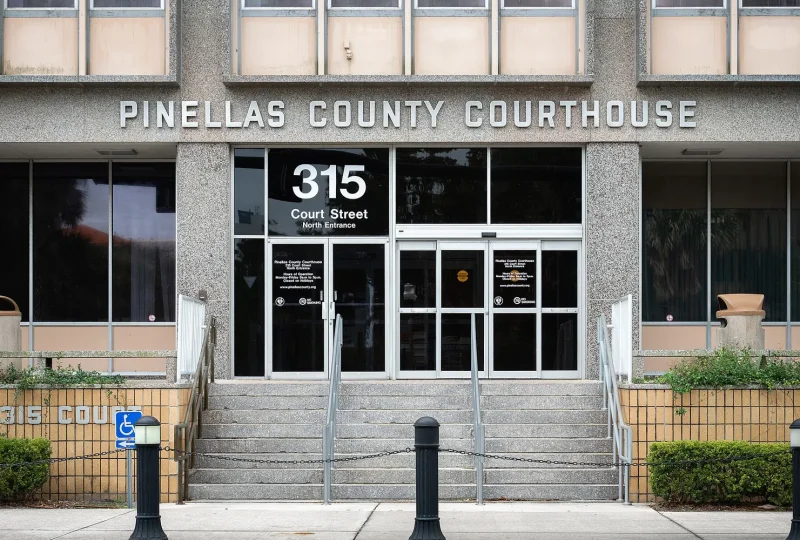
Section 34.01, Florida Statutes, gives the county court jurisdiction over misdemeanor cases, except a misdemeanor charged with a felony arising from the same circumstances, which goes to circuit court (section 26.012, Florida Statutes). In Pinellas County both courts sit at the Pinellas County Justice Center in Clearwater.
- First appearance. A person who is arrested and not released sees a judge within 24 hours. See what happens at first appearance in Florida.
- The formal charge. The State Attorney’s Office decides whether to file a charge and which one. In a misdemeanor case the charge can be an information or the notice to appear itself.
- Arraignment. The charge is read and a plea is entered. A lawyer can file a written plea of not guilty instead. A person who comes to court on a notice to appear may, under Rule 3.125, give up the right to a lawyer and a trial and plead guilty or no contest that day. A plea ends the case with a criminal disposition, so it has lasting effects.
- Pretrial. Evidence is exchanged and motions are heard. Rule 3.191 gives the right to be brought to trial within 90 days of being formally charged, a period that can be waived.
- Resolution. A case can end in a dismissal, a diversion program, a plea, or a trial before a judge or a six-member jury.
Section 775.15, Florida Statutes, generally requires a prosecution to begin within two years for a first-degree misdemeanor and one year for a second-degree misdemeanor, with exceptions.
The right to a lawyer
Under Florida Rule of Criminal Procedure 3.111, a person who cannot afford a lawyer is entitled to an appointed one in any prosecution for an offense punishable by incarceration, which includes misdemeanors. The exception is a misdemeanor case in which the judge files a written order, at least 15 days before trial, certifying that the defendant will not be incarcerated. A request for the public defender is made on an application to the clerk (section 27.52, Florida Statutes).
When a misdemeanor becomes a felony
- Battery. A new battery by a person with a qualifying prior conviction is a third-degree felony. See battery in Florida.
- Petit theft. Petit theft by a person with two or more prior theft convictions is a third-degree felony. See theft in Florida.
- Domestic violence. Since July 1, 2026, a prior domestic violence conviction reclassifies a new first-degree misdemeanor as a third-degree felony. See domestic violence charges in Florida.
- DUI. A third DUI within 10 years of a prior conviction, and any fourth DUI, is a third-degree felony.
A misdemeanor and your record
A person who has been adjudicated guilty of any crime in Florida, including a misdemeanor, generally cannot have a record sealed or expunged by court order. When a judge withholds adjudication, sealing may be possible, but some offenses, such as an assault or battery involving domestic violence, are excluded even then. See sealing or expunging a Florida criminal record. A conviction can also affect employment, professional licenses, and, for people who are not U.S. citizens, immigration status.
Common questions
Can you go to jail for a misdemeanor in Florida?
Yes. The maximum is 60 days for a second-degree misdemeanor and one year for a first-degree misdemeanor, served in a county jail and not a state prison. Those are ceilings. The sentence in any case is decided by the judge.
Do I have to go to court for a misdemeanor?
A notice to appear or a release document requires the person to be in court on the date shown. A lawyer can file a written plea of not guilty in place of the arraignment. Missing a required date can lead to a warrant.
Does a misdemeanor come off your record after a number of years?
Not automatically. The record remains unless it is sealed or expunged, and eligibility depends on how the case ended and on the person’s whole record.
When to speak with an attorney
A misdemeanor is the lowest level of crime in Florida, but it can still mean jail, probation, and a criminal record. A licensed Florida attorney can explain the options in a specific case. A person who cannot afford a lawyer can ask the court to appoint the public defender. The attorney consultation checklist can help you prepare, and more guides are on the Misdemeanors topic page.
Official resources and sources
- Section 775.08, Florida Statutes — definitions of felony, misdemeanor, and noncriminal violation
- Section 775.081, Florida Statutes — classification of offenses
- Section 775.082, Florida Statutes — maximum terms of imprisonment
- Section 775.083, Florida Statutes — fines
- Section 948.15, Florida Statutes — misdemeanor probation
- Section 34.01, Florida Statutes — jurisdiction of the county court
- Section 901.15, Florida Statutes — arrest without a warrant
- Section 775.15, Florida Statutes — time limits for starting a prosecution
- Florida Rules of Criminal Procedure — Rules 3.111, 3.125, 3.140, 3.160, and 3.191, as published October 1, 2026
- Pinellas County Sheriff’s Office — Adult Pre-Arrest Diversion program