On this page
Quick answer
Florida has no single crime called “domestic violence.” Section 741.28, Florida Statutes, uses the term for offenses such as assault, battery, and stalking when one family or household member commits them against another. The underlying offense sets the basic penalty. The label adds its own rules: the person is held until a judge sets release conditions, a conviction involving intentional bodily harm carries a minimum jail term, and probation lasts at least a year. Since July 1, 2026, a prior domestic violence conviction also raises the level of a new offense.
Key takeaways
- The State Attorney decides whether to prosecute, even over the objection of the alleged victim.
- A person arrested for domestic violence is held until a judge decides release, which normally comes with an order of no contact.
- If guilt is adjudicated and the person intentionally caused bodily harm, the court must order at least 10 days in jail for a first offense.
- A plea of guilty or no contest to a domestic violence assault or battery cannot be sealed or expunged, even if adjudication is withheld.
- Since July 1, 2026, a prior domestic violence conviction raises a new domestic violence offense by one level.
What “domestic violence” means in Florida
The definitions are in section 741.28, Florida Statutes, and are set out in our summary of section 741.28.
- Domestic violence means any assault, aggravated assault, battery, aggravated battery, sexual assault, sexual battery, stalking, aggravated stalking, kidnapping, false imprisonment, or any criminal offense resulting in physical injury or death, committed by one family or household member against another.
- Family or household member means spouses, former spouses, people related by blood or marriage, people who live together as if a family or who have done so in the past, and people who have a child in common whether or not they were ever married. Except for people who have a child in common, the two must live together now, or have lived together in the past, in the same single dwelling unit.
The charge is the underlying offense. Battery, for example, is a first-degree misdemeanor with a maximum of one year in jail. Our guide to battery in Florida sets out each level.
What the domestic violence label adds
Arrest and release
Under section 741.29, Florida Statutes, an officer with probable cause may make an arrest without the alleged victim’s consent. The person cannot post bond from the schedule: section 741.2901, Florida Statutes, requires that they be held until brought before a judge, which happens at first appearance within 24 hours.
No-contact orders
Florida Rule of Criminal Procedure 3.131 makes no contact with the alleged victim a condition of pretrial release unless the court modifies it. Under section 903.047, Florida Statutes, an order of no contact prohibits the following unless the judge says otherwise:
- communicating with the protected person in any way, directly or through someone else;
- physical or violent contact with the person or their property;
- being within 500 feet of the person’s home, even if the defendant also lives there; and
- being within 500 feet of the person’s vehicle, workplace, or another place named in the order.
The order takes effect immediately and lasts while the person is on pretrial release, or until the court changes it. Only the judge can modify it. The statute has no exception for contact that the protected person agrees to or starts.
Willfully violating a release condition in a domestic violence case is a first-degree misdemeanor under section 741.29. Since October 1, 2026, section 903.0472, Florida Statutes, also makes it a crime to willfully violate a no-contact order imposed after an arrest for certain violent offenses.
Minimum jail terms
Section 741.283, Florida Statutes, applies when a person is adjudicated guilty of a crime of domestic violence and intentionally caused bodily harm to another person. The court must then order a minimum term in the county jail:
| Offense | Minimum jail term | If committed in the presence of a child under 16 who is a family or household member of the victim or the defendant |
|---|---|---|
| First | 10 days | 15 days |
| Second | 15 days | 20 days |
| Third or subsequent | 20 days | 30 days |
The minimum does not apply if the court imposes a state prison sentence instead. See our summary of section 741.283.
Probation and a batterers’ intervention program
Under section 741.281, Florida Statutes, a person who is found guilty of, has adjudication withheld on, or pleads no contest to a crime of domestic violence must be placed on at least one year of probation and ordered to complete a batterers’ intervention program, unless the court states on the record why the program might be inappropriate.
The 2026 law: prior convictions raise the level
Chapter 2026-86, Laws of Florida, took effect on July 1, 2026 and created section 741.2801, Florida Statutes. If a person already has a conviction for a crime of domestic violence when they commit a new one, the new offense is reclassified one level up. A second-degree misdemeanor becomes a first-degree misdemeanor, a first-degree misdemeanor becomes a third-degree felony, and each felony degree moves up one step. A “conviction” includes a plea of guilty or no contest even when adjudication was withheld. The section does not apply to felony battery under section 784.03(2).
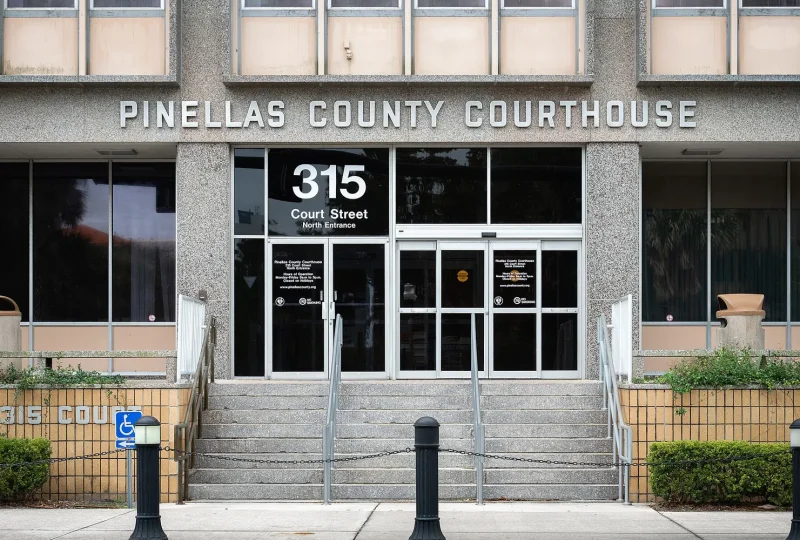
The same act made it a third-degree felony for a person with a prior conviction for domestic violence, or for violating an injunction, to violate an injunction against the same victim (section 741.31, Florida Statutes). It also set up electronic monitoring pilot programs in Pinellas County and the Sixth Judicial Circuit that run from July 1, 2026 through June 30, 2028. Read the official text for the details.
Firearms and the record
- Firearms. Federal law, 18 U.S.C. § 922(g)(9), prohibits a person convicted of a misdemeanor crime of domestic violence from possessing a firearm.
- Sealing and expunction. Under section 943.0584, an assault or battery by one family or household member against another cannot be sealed or expunged if the case ended in a finding of guilt or a plea of guilty or no contest, whether or not adjudication was withheld. See sealing or expunging a Florida criminal record.
What happens next
At first appearance, within 24 hours of the arrest, a judge sets the conditions of release. The State Attorney then decides whether to file a charge. Section 741.2901, Florida Statutes, directs each State Attorney to adopt a pro-prosecution policy for domestic violence and says prosecutors make that decision “over the objection of the victim, if necessary.” A misdemeanor is heard in county court and a felony in circuit court. See how the Florida criminal court process works.
An injunction for protection against domestic violence (section 741.30) is a separate matter, requested by a petition in circuit court. Willfully violating one is a first-degree misdemeanor under section 741.31.
Common questions
Can the alleged victim drop a domestic violence charge in Florida?
No. The charge is brought by the State, and the prosecutor’s decision can be made over the alleged victim’s objection.
Can we live together while a no-contact order is in place?
Not unless the judge changes the order. A no-contact order bars the defendant from being within 500 feet of the protected person’s home, even when it is the defendant’s home too. A request to modify the order is made to the court.
Is domestic battery a misdemeanor or a felony?
Battery is a first-degree misdemeanor. It is charged as a felony when it involves strangulation, great bodily harm, or a deadly weapon, when the person has a qualifying prior battery conviction, or, since July 1, 2026, when the person has a prior domestic violence conviction.
When to speak with an attorney
A no-contact order can affect where a person lives from the first day, and a plea can mean a record that cannot be sealed and the loss of the right to possess a firearm. A licensed Florida attorney can explain the options, including how to ask the court to modify a release condition. A person who cannot afford a lawyer can ask the court to appoint the public defender. More guides and statute summaries are on the Domestic Violence topic page.
If you are in danger, call 911. The National Domestic Violence Hotline is available at 1-800-799-7233.
Official resources and sources
- Section 741.28, Florida Statutes — definitions
- Section 741.2801, Florida Statutes — enhanced penalties for a prior conviction (created 2026)
- CS/CS/HB 277 (2026), chapter 2026-86, Laws of Florida — The Florida Senate
- Section 741.281, Florida Statutes — probation and batterers’ intervention program
- Section 741.283, Florida Statutes — minimum term of imprisonment
- Section 741.29, Florida Statutes — arrest; violation of release conditions
- Section 741.2901, Florida Statutes — prosecution policy
- Section 741.31, Florida Statutes — violation of an injunction
- Section 903.047, Florida Statutes — orders of no contact
- Section 903.0472, Florida Statutes — violation of a no-contact order
- National Domestic Violence Hotline — 1-800-799-7233